

Industrial Radiography: How Radioactive Sources Are Used and Shipped
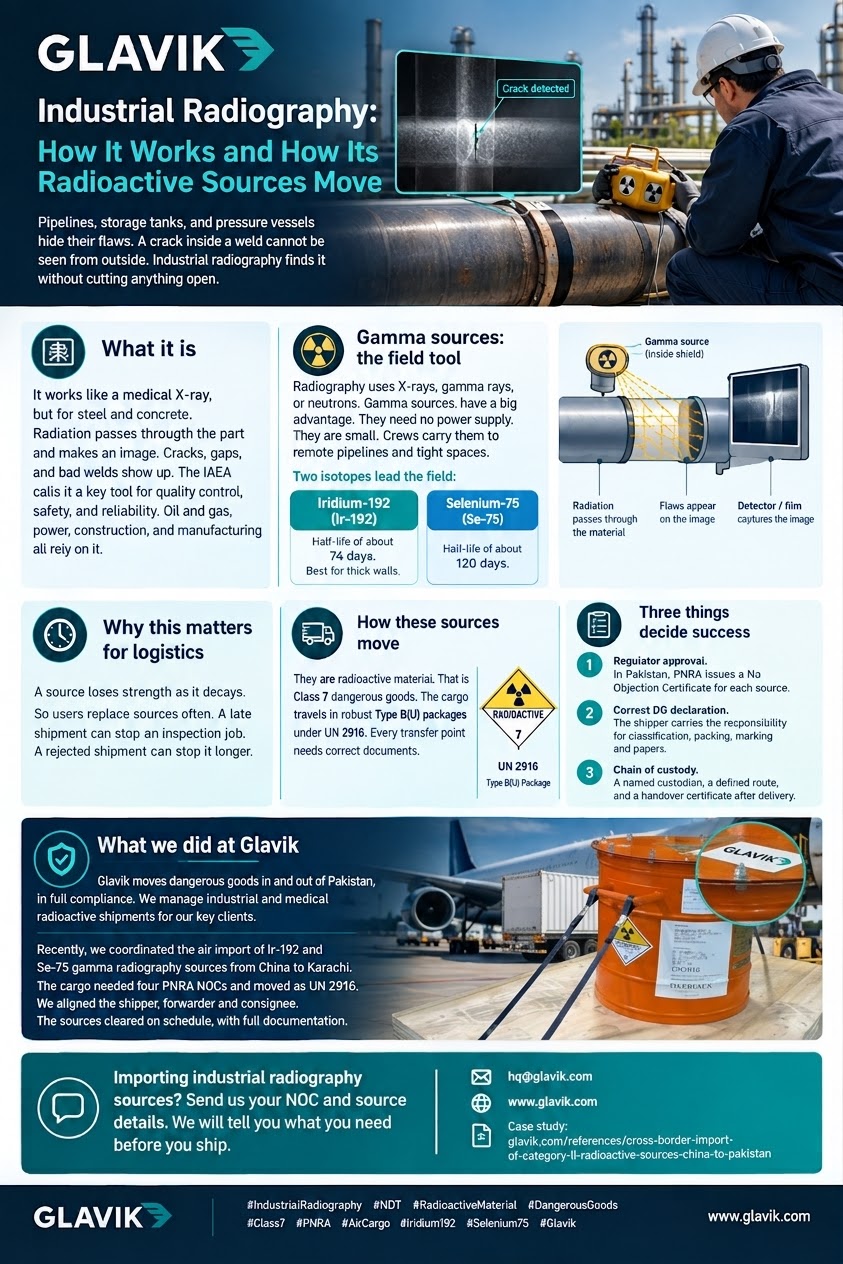
Pipelines, storage tanks, and pressure vessels hide their flaws. A crack inside a weld cannot be seen from outside. Industrial radiography finds it without cutting anything open.
What industrial radiography is
It works like a medical X-ray, but for steel and concrete. Radiation passes through the part and makes an image. Cracks, gaps, and bad welds show up.
The International Atomic Energy Agency (IAEA) describes it as a major method of non-destructive testing. Inspectors use it on welds in gas and water pipelines, storage tanks, structural elements, and concrete. The IAEA calls this technology a key tool for quality control, safety, and reliability.
Oil and gas, power, construction, and manufacturing all rely on it.
Gamma sources: the field tool
Radiography uses X-rays, gamma rays, or neutrons. Gamma sources have clear advantages. They need no power supply. The equipment is small and light. Crews can carry it to remote pipelines and tight spaces.
Two isotopes lead the field.
| Isotope | Half-life | Best use |
| Iridium-192 (Ir-192) | About 74 days | Thicker walls |
| Selenium-75 (Se-75) | About 120 days | Thinner walls, from about 5 mm of steel |
Se-75 is made in a nuclear reactor. It emits gamma rays at 136, 265, and 401 keV, and it decays to stable arsenic-75. A 2006 study at the Asia-Pacific Conference on NDT found that Se-75 gave better contrast than Ir-192 on thinner steel. It also found that X-ray is still better at spotting fine cracks.
Why this matters for logistics
A source loses strength as it decays. So users replace sources often. A late shipment can stop an inspection job. A rejected shipment can stop it longer.
How radioactive sources move
These sources are radioactive material. That makes them Class 7 dangerous goods. The cargo travels in robust Type B(U) packages under UN 2916. Every transfer point needs correct documents.
Four things decide success:
- Regulator approval. In Pakistan, the Pakistan Nuclear Regulatory Authority (PNRA) issues a No Objection Certificate (NOC) for each source. It sets the isotope, the activity, and the validity dates.
- Correct DG declaration. The shipper carries the responsibility for classification, packing, marking, and papers.
- Chain of custody. A named custodian, a defined route, and a handover certificate after delivery.
- Matching paperwork. Many imports run on a Letter of Credit. One mismatch between the invoice, packing list, and insurance can hold both the cargo and the payment.
Remember: Airlines have strict acceptance checks for DG cargo. Those checks do not move the shipper’s liability. A wrong declaration is the shipper’s problem.
What we do at Glavik
Glavik moves dangerous goods in and out of Pakistan, in full compliance. We manage industrial and medical radioactive shipments for our key clients.
Take one recent case. We coordinated the air import of Ir-192 and Se-75 gamma radiography sources from Chengdu, China to Karachi. The route ran through Guangzhou and Istanbul.
- Four separate PNRA NOCs
- UN 2916, Category II-Yellow, with X-ray screening at origin
- One team aligning the overseas shipper, the forwarder, the bank, the insurer, and the PNRA-licensed consignee
- All documents matched before the cargo reached Karachi
The sources cleared on schedule, with full documentation.
Radioactive cargo leaves no room for error. We handle the approvals, the DG paperwork, and the movement as one job.
Our advice if you import radioactive sources
- Apply for your NOCs early.
- Check the isotope, the activity, and the package type against your NOC.
- Name your custodian before the cargo moves.
- Match every shipping document to your Letter of Credit terms.
- Plan for decay. Order before your source runs low.
Frequently asked questions
What is industrial radiography?
It is a non-destructive testing method. It uses X-rays, gamma rays, or neutrons to see hidden flaws inside welds, pipes, tanks, and concrete.
Which radioactive sources are common in industrial radiography?
Iridium-192 and Selenium-75 are the two most common gamma sources.
Are radiography sources dangerous goods?
Yes. They are Class 7 radioactive material. They move as UN 2916 in Type B(U) packages.
What approval do I need to import radioactive sources into Pakistan?
You need a No Objection Certificate from PNRA for each source. Customs clearance and the shipment must fall within the NOC validity window.
Can Glavik handle radioactive imports end to end?
Yes. We coordinate NOCs, DG declarations, airline booking, customs, and delivery to the licensed consignee.
Importing industrial or medical radioactive sources?
Send us your NOC and source details. We will tell you what you need before you ship.
Email: hq@glavik.com | Web: www.glavik.com
Glavik | Landmark Plaza, Jail Road, Lahore, Pakistan | +92 321 4591020
Case study: Cross-border import of Category II radioactive sources, China to Pakistan