

The Cargo That Cannot Be X-Rayed: How to Ship Industrial Radiography Film
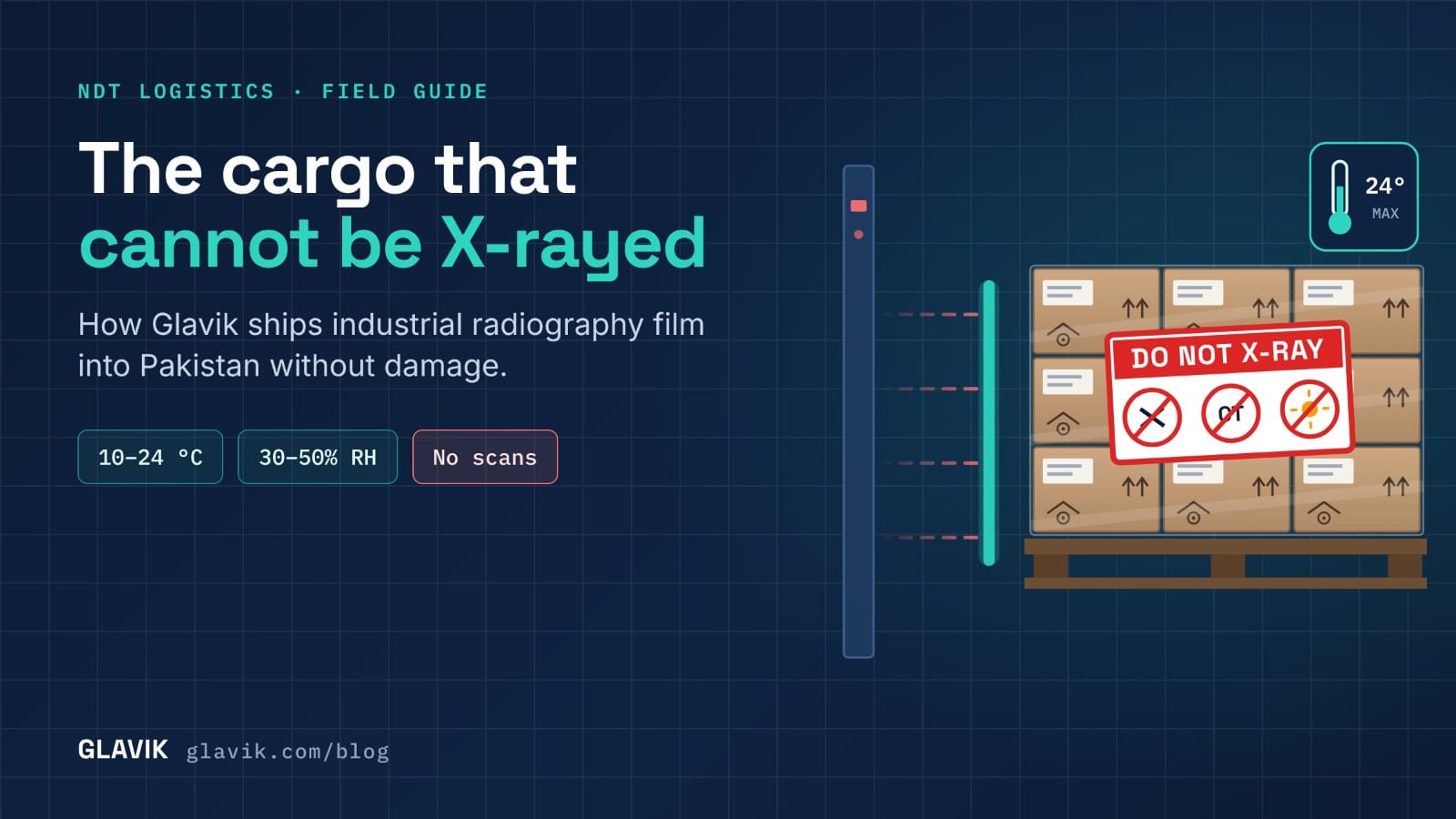
The scanner built to protect cargo can destroy this one
Every port scans containers. It keeps the supply chain safe. For most cargo, a scan is harmless.
For one product, a single scan can wipe out the whole shipment. Nothing breaks. Nothing leaks. The boxes look perfect. But when the customer opens them in a darkroom months later, every sheet is fogged and useless.
That product is industrial X-ray film. Right now, Glavik is moving three pallets of it into Pakistan. That is 1,661 kg of film, or about 125,500 sheets. Each one is designed to react to X-rays. That is its job. It cannot tell the difference between a weld inspection and a customs scanner.
This guide explains what this film is, why it is so easy to damage, and how we ship it safely.
What industrial X-ray film is
Industrial X-ray film lets inspectors see inside solid objects without cutting them open. This is called non-destructive testing (NDT). An X-ray or gamma source sits on one side of the part. The film sits on the other. Cracks, voids and bad welds show up as marks on the developed film.
The film in this shipment is made in the USA by Carestream under the INDUSTREX name. It covers two types:
| Film | What it is | Typical uses (per Carestream) |
| INDUSTREX AA400 | High-speed, fine-grain film. ASTM E1815 Class II. Handles heat, humidity and static well. | Pipelines, welded fabrication, castings, aircraft, concrete, tyres |
| INDUSTREX MX125 | Ultra-fine grain, very high contrast. ASTM E1815 Class I. Built for critical work. | Aircraft and aero-engines, pipelines, precision castings, high-quality welds |
In Pakistan, this film supports pipeline and refinery inspection, power plants, aviation maintenance and heavy fabrication. When it arrives damaged, inspection work stops.
Four things that damage film before it is used
Carestream’s technical data sheets set clear limits for unexposed film. Break any one of them and the film can fail.
| Threat | The limit | What goes wrong |
| Radiation | Shield from X-rays, gamma rays and any penetrating radiation | The film records the scan. Fog covers every sheet. |
| Heat | Store at 10–24 °C (50–75 °F) | Fog builds up and image quality drops |
| Humidity and cold | 30–50% relative humidity. Do not refrigerate or freeze. | Condensation forms. Sheets can stick together. |
| Pressure | Handle by the edges. No creasing or buckling. | Pressure marks show up as dark spots on the image |
Radiation is the biggest risk. The film is made to capture X-rays, so it cannot ignore them. AA400 is a high-speed film. Carestream’s own exposure table shows it needs about one third of the exposure MX125 needs. Faster film means stray radiation does damage sooner.
There is a catch with heat, too. Film that arrives hot cannot be put straight into cold storage. The sudden change causes condensation. That is why the data sheet says do not refrigerate.
Film also expires. Every box carries a date. Stock that sits in a hot port for weeks loses useful life before it reaches the user.
Read the box: the symbols most people miss
The carton tells you how to handle it. Most people in the chain never read it. Here is what each mark on these film cartons means.
| Symbol on the carton | What it means | What the handler must do |
| Thermometer with “24 °C / 75 °F” at the top | Upper temperature limit | Keep below 24 °C. No open yards, no direct sun. |
| Sun and radiation trefoil under a roof over a box | Protect from heat and from radioactive sources | Keep away from heat, scanners and any radiation source |
| Two upward arrows | This way up | Load and stack upright |
| Product label (e.g. “100 NIF”) | 100 non-interleaved sheets per pack, plus size, lot and expiry date | Check the expiry date and lot match the paperwork |
| Round stamp from the box maker | Strength certificate for the corrugated carton | Do not exceed safe stacking |
The radiation trefoil on the carton does not mean the film is radioactive. It is not dangerous goods. It means the opposite: the film must be kept away from radiation.
That confuses people. A trefoil on a box can make a handler more likely to send it for a scan, not less. This is the same problem we wrote about with the CAO label. A label only works if every person in the chain understands it.
Why shipping film is hard: scanners and heat
The two biggest risks in transit are the scanner and the steel box.
Scanners. Pakistan Customs uses a Non-Intrusive Inspection System at KICT and SAPT in Karachi and QICT at Port Qasim. It started in April 2021. A computer picks containers for scanning based on risk profiles. Customs has its own scanners, and the terminal operators have theirs. (FBR)
Container scanners need strong X-rays to see through steel walls. That is fine for steel bars or textiles. For unexposed film, it is the one thing it must avoid. And the selection is automatic. The system does not know the box holds film unless someone tells it.
Air cargo has the same problem. Cargo is screened before it is loaded, and the film cannot opt out.
Heat. A steel container in the sun turns into an oven. Marine surveyor Charles Taylor reported a recent case of heat-damaged photographic paper. Inside the container, temperatures reached 38–50 °C. Outside, the air was only 30–31 °C. (Maritime Professional)
The film’s limit is 24 °C. A container that sits in a Karachi terminal yard in summer can pass that limit within hours. Every extra day of port dwell time adds risk.
How Glavik is handling this shipment
This is a live job. Here is what we are moving and how.
The shipment: US-made Carestream film, moving by sea from the UAE to Karachi International Container Terminal (KICT), then on to Lahore.
| Detail | This shipment |
| Products | INDUSTREX AA400 (10 × 24 cm and 10 × 40 cm), INDUSTREX MX125 (35 × 43 cm) |
| Volume | 1,255 packs of 100 sheets, 4,675 m² of film |
| Pallets | 3 pallets, 1,661 kg total |
| HS code | 3701.10 (X-ray film, unexposed) |
| Expiry | 11/2028 (AA400), 01/2029 (MX125) |
Here is how we protect it, step by step.
- Label every pallet face. Each pallet carries “DO NOT X-RAY” placards with clear icons: do not X-ray, do not CT scan, protect from heat. Labels go on more than one side, so they are seen whichever way the pallet faces.
- Build the pallets to resist pressure. Cartons are stacked upright, arrows up, and stretch-wrapped tight. Nothing heavy rides on top.
- Get the paperwork exact. We checked the bill of lading draft line by line against the invoice. Product names, sizes, HS code, expiry dates and pallet sizes all match. The letter of credit terms are quoted correctly. One mismatch can trigger a customs hold, and every day held is a day in the heat.
- Tell customs before the container lands. Our in-house customs team flags the goods declaration as X-ray-sensitive film. If customs wants to examine it, we ask for a physical check in a shaded area, not a scan.
- Ask for cool stowage. We ask the carrier to stow the container below deck, away from heat sources, and to avoid long stays in the open yard.
- Clear fast and move fast. Clearance documents are ready before arrival. The aim is fewer days in the Karachi terminal and a quick move to the customer’s store in Lahore.
Checklist for importers of X-ray film
Use this before your next order ships.
Before dispatch
- ☐ “DO NOT X-RAY” labels on every pallet face, not only one side
- ☐ Cartons upright, stretch-wrapped, nothing heavy stacked on top
- ☐ Expiry dates checked. Plenty of shelf life left after a slow transit.
- ☐ Invoice, packing list and bill of lading match on product, size, HS code and quantity
In transit
- ☐ Carrier asked for below-deck stowage, away from heat
- ☐ Customs team briefed before arrival: request a physical check, not a scan
- ☐ Clearance documents ready before the vessel arrives
On arrival
- ☐ Store at 10–24 °C and 30–50% humidity
- ☐ Let warm film reach room temperature slowly. Never put it in a fridge.
- ☐ Use older stock first
Frequently asked questions
Can industrial X-ray film go through a cargo scanner?
No. Unexposed industrial X-ray film must be shielded from X-rays, gamma rays and any penetrating radiation. A cargo scan can fog every sheet.
Is X-ray film dangerous goods?
No. It is not radioactive and not regulated as dangerous goods. The radiation symbol on the carton means “keep away from radiation”.
What temperature should X-ray film be stored at?
Carestream recommends 10–24 °C (50–75 °F) and 30–50% relative humidity for unexposed film. Do not refrigerate or freeze it.
What is the HS code for X-ray film?
Unexposed X-ray film in flat sheets falls under HS 3701.10.
How can you tell if film was damaged by X-rays?
You usually cannot tell from the box. The damage shows only when the film is developed, often as an even grey fog.
Does Glavik handle X-ray film imports into Pakistan?
Yes. We handle the shipment end to end: labelling, documents, sea or air freight, and customs clearance with our in-house team.
The film is only as good as the trip it took
A radiographer trusts the film to show the truth about a weld. If the film was fogged in transit, that trust is broken before the first exposure.
Shipping X-ray film is not about speed alone. It is about knowing what the product fears, reading the box, and making sure every person in the chain knows too. The shipper, the carrier, the terminal and the customs officer.
Glavik moves sensitive and regulated cargo into Pakistan across 45+ countries of origin: medical equipment, pharma, dangerous goods and NDT supplies. We deliver certainty when it matters most.
Importing X-ray film or other sensitive cargo?
Get a Compliance-Ready Quote in 24 Hours – Guaranteed.
#IndustrialRadiography #NDT #XRayFilm #HealthcareLogistics #Pakistan #Glavik
Sources
- Carestream, INDUSTREX AA400 Film Technical Data Sheet CHSP-8969 (storage, handling, relative exposure)
- Carestream, INDUSTREX MX125 Film Technical Data Sheet CHSP-8987, Rev B, January 2024
- FBR: Automated process for scanning of cargo, 21 April 2021
- Maritime Professional: When the Climate Becomes a Cargo Risk, 7 April 2026