

The Cargo Aircraft Only (CAO) Label: What It Means and Why It Still Gets Missed
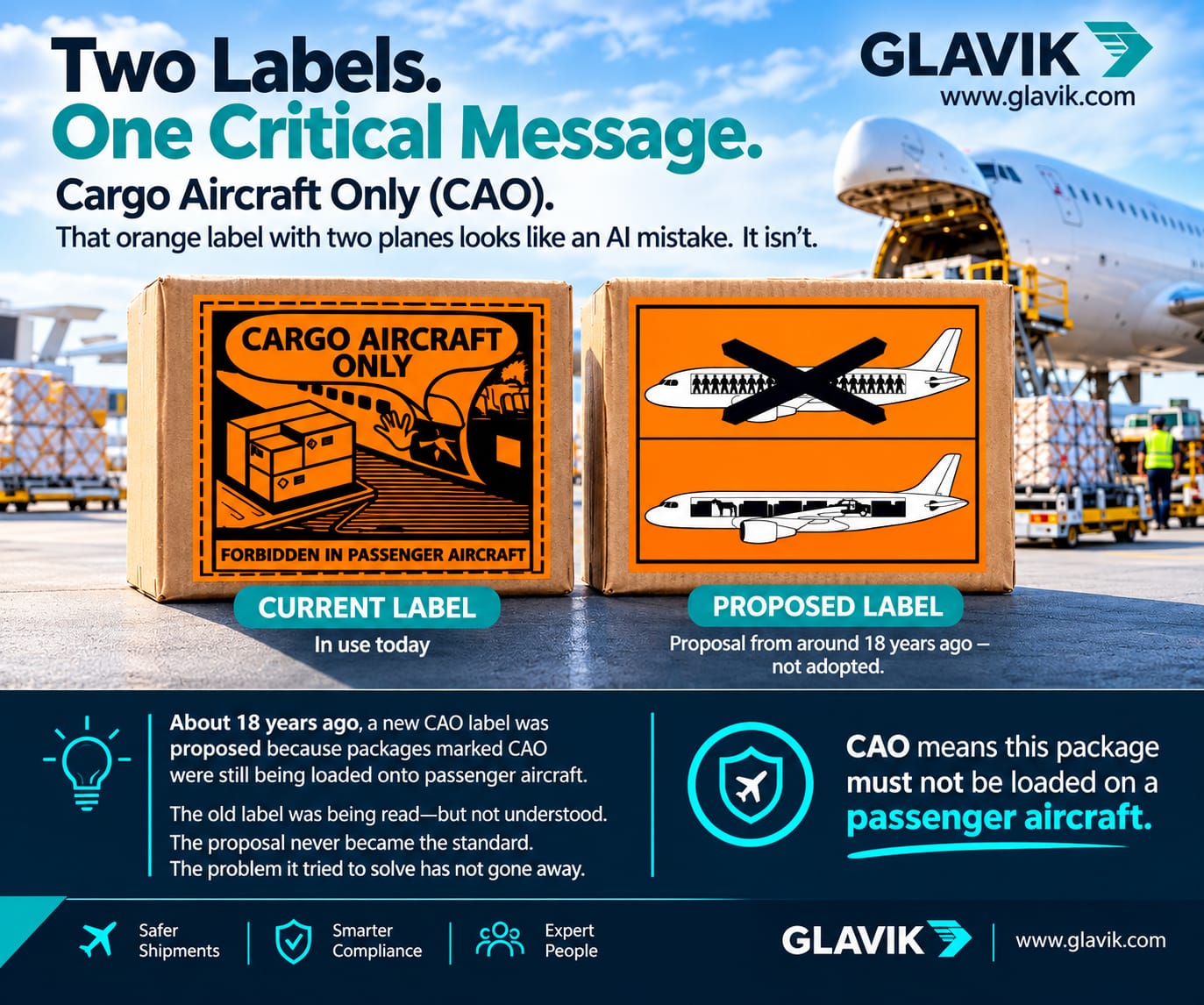
That orange label with two planes looks like an AI mistake. It isn’t.
About 18 years ago, it was a real proposal for a new Cargo Aircraft Only (CAO) label. The reason was simple. Packages marked CAO were being loaded onto passenger aircraft. The old label was being read but not understood.
The proposal did not become the standard. The problem it tried to solve has not gone away.
What does the Cargo Aircraft Only label mean?
A CAO label means one thing. This package must never fly with passengers.
The current label is orange with a black aircraft symbol. It reads “Cargo Aircraft Only” and “Forbidden in Passenger Aircraft”. It goes on the same side of the package as the hazard labels, close to them.
The CAO label does not replace the hazard label. It sits next to it. The hazard label says what the danger is. The CAO label says which aircraft can carry it.
Which dangerous goods are Cargo Aircraft Only?
Some dangerous goods are allowed by air only in limited quantities, and only on freighters. Common examples:
- Lithium ion and lithium metal batteries shipped on their own (UN3480 and UN3090)
- Some flammable liquids, above the passenger aircraft limit
- Certain toxic and corrosive chemicals
Healthcare shipments are not exempt. Lab reagents, solvents and spare battery packs for medical devices can all fall under CAO rules.
The IATA Dangerous Goods Regulations (DGR) decide this. In the List of Dangerous Goods, each entry shows a passenger aircraft limit and a cargo aircraft limit. If the passenger column says “Forbidden”, the item can only fly on a freighter.
Put CAO cargo on the wrong aircraft and the safety margin is gone.
Why CAO cargo still ends up on passenger flights
A label only works if every person in the chain knows what it means:
- The shipper who packs it.
- The forwarder who books it.
- The ground handler who builds the pallet.
- The load planner who decides which aircraft it goes on.
One weak link is enough.
Glavik’s CAO checklist before cargo leaves the shipper’s door
At Glavik, we check four things before any dangerous goods shipment moves:
- Is the item CAO under the current IATA DGR?
- Is the correct label applied, at the right size, on the right side?
- Is the booking on a freighter, not a passenger flight?
- Does the shipper’s declaration match the package?
If any answer is no, the cargo does not move until it is fixed.
Labels don’t keep cargo safe. Trained people do.
Glavik handles dangerous goods and temperature-controlled healthcare cargo from Pakistan to 45+ countries. If you are shipping lithium batteries, lab chemicals or other regulated goods by air, talk to our team before you book. Contact Glavik
Frequently asked questions
What does a Cargo Aircraft Only label mean?
The package must only travel on a freighter. It is forbidden on passenger aircraft.
What size is the CAO label?
The standard minimum is 120 mm x 110 mm. It goes on the same side as the hazard labels, close to them.
Are lithium batteries Cargo Aircraft Only?
Lithium ion (UN3480) and lithium metal (UN3090) batteries shipped on their own are forbidden on passenger aircraft. Batteries packed with or inside equipment follow different rules.
How do I know if my shipment is CAO?
Check the item in the List of Dangerous Goods in the current IATA DGR. If the passenger aircraft column says “Forbidden” and the cargo aircraft column allows it, it is CAO.
Who is responsible for the CAO label?
The shipper must mark and label the package correctly. The forwarder, ground handler and load planner must each check it before the cargo moves.