

If Afghanistan Bans Pakistan-Manufactured Pharma: Strategic Survival & Expansion Blueprint
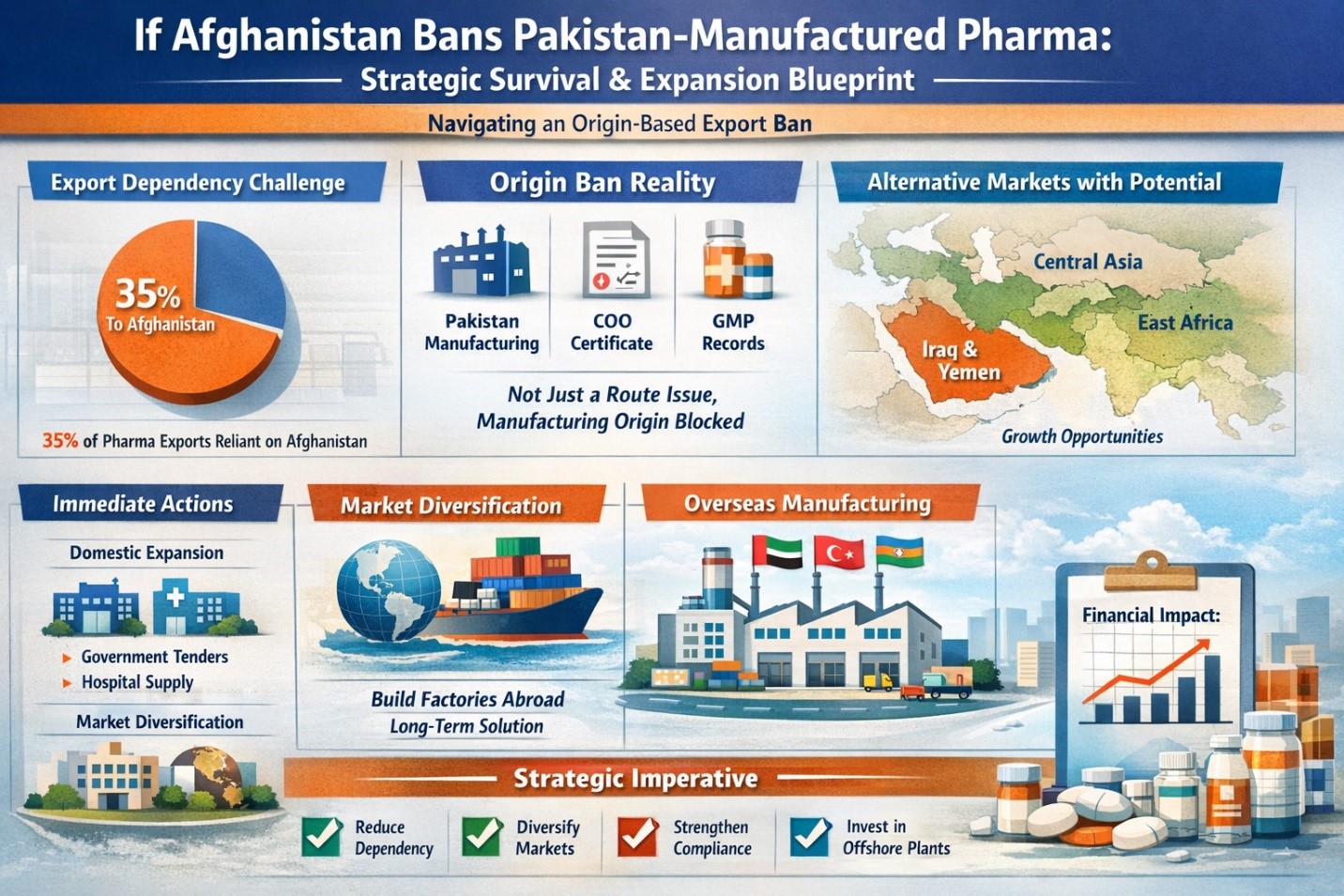
The first chart clearly shows the structural issue:
📊 35% export dependency on one market.
When one country accounts for over one-third of pharmaceutical exports, any origin-based ban becomes a revenue shock event, not just a trade disruption.
If Afghanistan bans Pakistan-manufactured pharmaceutical goods, exporters must immediately shift from tactical thinking to strategic restructuring.
1. Immediate Reality: This Is Not a Logistics Problem
If the restriction is based on the country of manufacture, then:
- Routing through another country will not solve it.
- Repacking or relabeling will not solve it.
- Trading invoices from third countries will not solve it.
Pharmaceutical origin is embedded in:
- GMP certificates
- Product registration dossiers
- Batch release documentation
- Manufacturing site approvals
This becomes a structural market access issue.
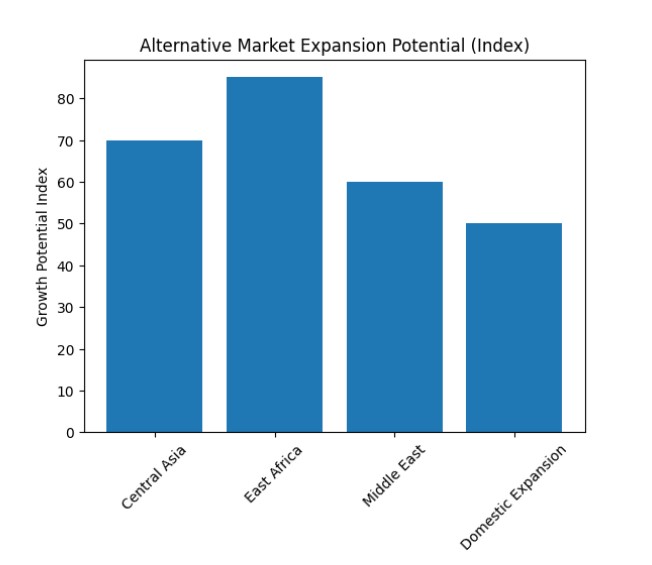
2. Where Is the Opportunity? (See Growth Potential Chart)
The second graph highlights expansion potential across alternative markets.
Highest Potential: East Africa
- Strong demand for generics
- Low-cost medicine dependence
- Expanding healthcare budgets
Stable Opportunity: Central Asia
- Uzbekistan
- Tajikistan
- Kyrgyzstan
These markets share demand characteristics similar to Afghanistan but with lower political volatility.
Middle East (Selective Penetration)
Iraq remains a realistic substitute market with comparable consumption patterns.
3. What Can Be Done Immediately? (0–6 Months)
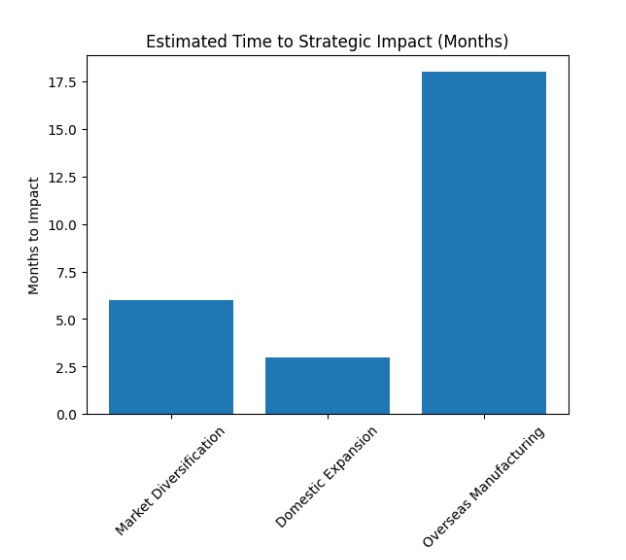
Referencing the third chart on time-to-impact:
Fastest Revenue Stabilizer: Domestic Expansion (3 Months)
- Increase participation in government tenders
- Strengthen institutional hospital supply
- Push high-volume SKUs locally
Medium-Speed Strategy: Market Diversification (6 Months)
- Activate distributors in Africa & Central Asia
- Accelerate product registrations
- Reallocate export sales teams
These steps cushion immediate financial exposure.
4. Structural Solution: Overseas Manufacturing (18+ Months)
If the ban persists long-term, companies must evaluate:
- Contract manufacturing in UAE or Turkey
- Joint ventures in Central Asia
- Toll manufacturing agreements
Only substantial manufacturing outside Pakistan can legally change product origin.
This requires:
- GMP-compliant facilities
- Regulatory re-registration
- Capital investment
- Time
But it provides durable access.
5. Board-Level Strategic Reset
This situation exposes a larger issue:
No single export market should exceed 20–25% of total revenue.
If Afghanistan accounts for 35%, concentration risk is already elevated.
The solution is not temporary routing adjustments.
The solution is:
- Multi-region regulatory footprint
- Geographic revenue balance
- Offshore distribution infrastructure
- Export risk management framework
6. Financial Impact Considerations
If 35% of exports halt:
- Production utilization drops
- Working capital cycles strain
- Inventory buildup risk increases
- Cash flow planning becomes critical
Immediate actions required:
- Adjust production forecasts
- Reduce Afghanistan-specific SKUs
- Tighten receivables exposure
- Secure alternate distributor contracts
7. Strategic Transformation Opportunity
Trade disruptions historically force industries to mature.
If handled strategically, this could accelerate:
- ✔ Expansion into Africa
- ✔ Entry into regulated Middle East markets
- ✔ Investment in overseas manufacturing
- ✔ Stronger export governance systems
Short-term disruption can lead to long-term resilience.
Final Strategic Conclusion
If Afghanistan bans Pakistan-manufactured pharmaceuticals:
There are only three legitimate paths:
- Diversify markets rapidly
- Expand domestic revenue
- Establish manufacturing outside Pakistan
There is no sustainable documentation workaround in pharmaceutical trade.
This is a moment for industry-level strategic restructuring, not tactical adjustments.
1 Comment
I found this article very helpful. Dry ice is widely used because it provides strong cooling performance while leaving no water behind. It is suitable for frozen food transportation, laboratory testing, medical deliveries, industrial cooling, and many other applications where temperature control is critical.