

Why Your Dangerous Goods Shipment Got Rejected at the Airport
And How to Ensure Compliance Before It Reaches the Airline
Your dangerous goods shipment just got rejected at the airport. You lose 3-5 days. Your customer loses faith. Your next shipment is under scrutiny. One rejection becomes a pattern—and patterns kill relationships with airlines and customers alike.
Here’s what most exporters don’t realize: airline rejection isn’t random. It’s by design. Airlines have one job—enforce compliance, not negotiate it. And they do this job ruthlessly.
Dangerous Goods Rejection Isn’t an Accident
Most exporters think rejection happens by chance. A careless mistake. Bad luck. It doesn’t.
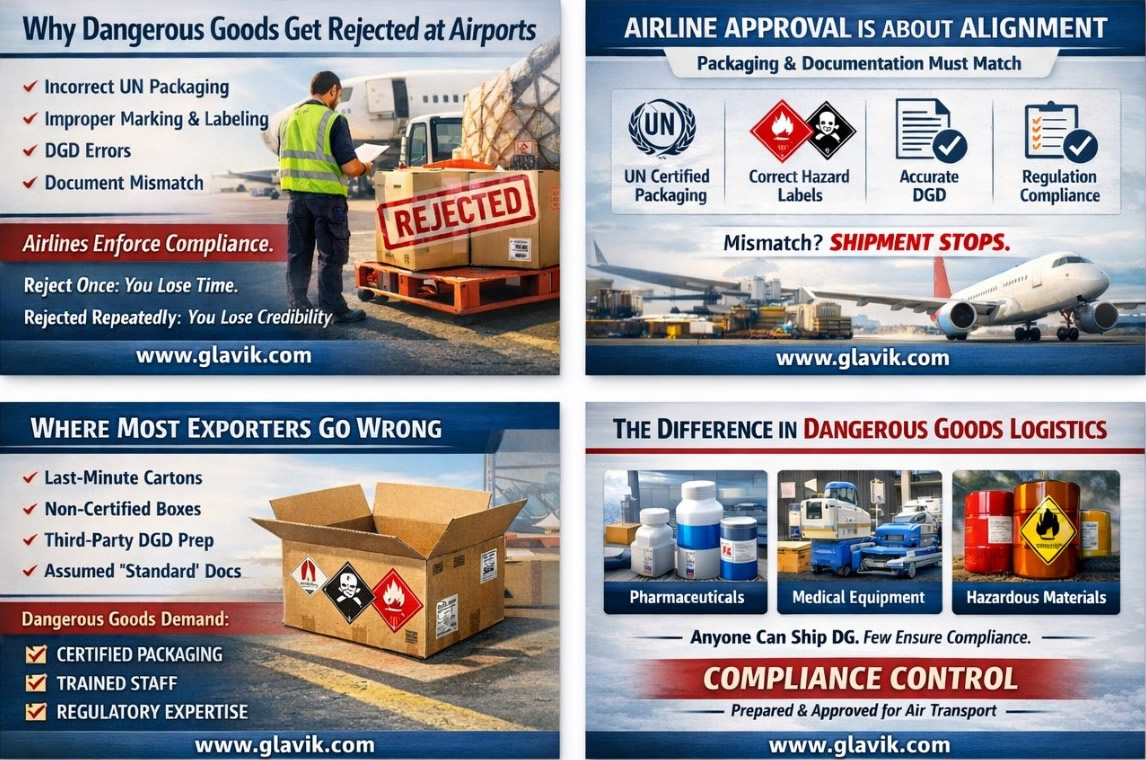
Dangerous goods shipments get rejected because of systematic failures in preparation. Here’s what triggers a rejection:
- Incorrect UN packaging—cartons that aren’t certified for hazardous materials
- Improper marking and labeling—missing or inaccurate hazard symbols
- DGD errors—a single incorrect entry in your Dangerous Goods Declaration
- Mismatch between documents and cargo—your declaration says one thing, your physical shipment shows another
When airlines discover any of these, they don’t negotiate. They don’t offer a grace period. They stop the shipment. And then they scrutinize every shipment you send afterward.

What Airlines Actually Check
Before any dangerous goods board an aircraft, airlines verify six critical elements. Understanding these is the first step to avoiding rejection:
- UN specification packaging—cartons must be certified for the specific hazard class
- Correct hazard labels—the right symbols, colors, and positioning
- Proper UN marking—identifying the material according to regulations
- Net quantity limits—ensuring you’re not exceeding the maximum per package
- Dangerous Goods Declaration accuracy—every field filled correctly
- Regulation compliance—adherence to IATA, ICAO, and local regulations
The moment any of these fails, the shipment stops.
If your carton says one thing and your DGD says another—shipment stops. If your packaging isn’t UN certified—shipment stops. If your DGD has a single incorrect entry—shipment stops.

Where Most Exporters Go Wrong
We’ve worked with hundreds of exporters. The pattern is always the same. They treat dangerous goods like standard cargo and pay the price.
Common mistakes we see:
- Sourcing cartons at the last minute—then realizing they’re not UN certified
- Using non-certified boxes—cheaper options that don’t meet hazmat standards
- Outsourcing DGD preparation to third parties—losing control of accuracy
- Assuming documentation is ‘standard’—not understanding that every material has unique regulatory requirements
Dangerous goods aren’t standard cargo. They require certified materials, trained personnel, regulatory understanding, and process control. Skip any one of these and you create risk that airlines catch before your customer does.
What Prevents Rejection
The path to airline approval starts before your cargo reaches the terminal. It starts with internal alignment.
Three elements must align perfectly:
- What you’re shipping (the physical cargo)
- How you’ve packaged it (UN-certified materials, proper markings)
- What your documentation says (accurate DGD, correct declarations)
Very few logistics providers can execute this consistently. Most handle the shipping part. Few handle the compliance part. Fewer still have dedicated teams for dangerous goods preparation and verification.
This is where we’re different.
How Glavik Ensures Airline Acceptance
We’re among the few in the industry who maintain full compliance control. Here’s what that means:
- We maintain ready stock of UN-certified cartons—for different packing groups and material types
- We source special specification cartons for specific hazard classifications
- We ensure proper UN marking according to air regulations—not generic standards
- We apply correct hazard labeling and handling marks—verified for accuracy
- We have a dedicated in-house dangerous goods packaging team—trained and certified
- We prepare and cross-verify every DGD with full regulatory compliance before cargo leaves
Before your cargo reaches the airline, we verify four critical checkpoints:
- ✓ Packaging alignment—certified materials, correct dimensions
- ✓ Labeling accuracy—hazard symbols, UN numbers, handling marks
- ✓ Documentation compliance—DGD accuracy, regulatory references
- ✓ Regulation alignment—IATA, ICAO, and local requirements
That internal alignment is what prevents airport rejection. That’s the difference between ‘we can ship it’ and ‘it will be accepted by the airline.’

The Real Cost of Getting It Wrong
One airport rejection costs you time and money. But the real cost is long-term.
- Time lost—3-5 days of delay per rejection
- Customer trust damaged—your shipper sees you as unreliable
- Airline reputation blackmarked—repeated rejections mean higher scrutiny on all future shipments
- Compliance risk—regulatory agencies notice patterns of non-compliance
One rejection isn’t the problem. It’s the message it sends: your processes aren’t reliable. And once you have that reputation with an airline, it’s extraordinarily hard to rebuild.

What Sets Dangerous Goods Apart
Anyone can forward dangerous goods. Very few can prepare them for airline approval.
In air shipments of pharmaceuticals, medical equipment components, and hazardous materials—you don’t just need logistics. You need compliance control.
Compliance control means someone is checking before the airline checks. Someone is verifying packaging, labeling, and documentation against actual regulatory requirements—not assumptions.
That’s the difference between shipments that move and shipments that get held.

Your Next Step
If you’re shipping dangerous goods, the question isn’t whether you can get them to the airport. The question is whether they’ll be accepted when they arrive.
Airlines verify compliance, not negotiate it. One rejection teaches you that lesson expensively. That’s why choosing a partner with built-in compliance control matters.
At Glavik, we’ve built our entire process around preventing rejection. Because we know that in dangerous goods logistics, compliance isn’t a feature. It’s everything.
