

Pharma Export from Pakistan to Afghanistan via Air Freight
Political Reality, Operational Challenges & How Glavik Ensures Guaranteed Delivery
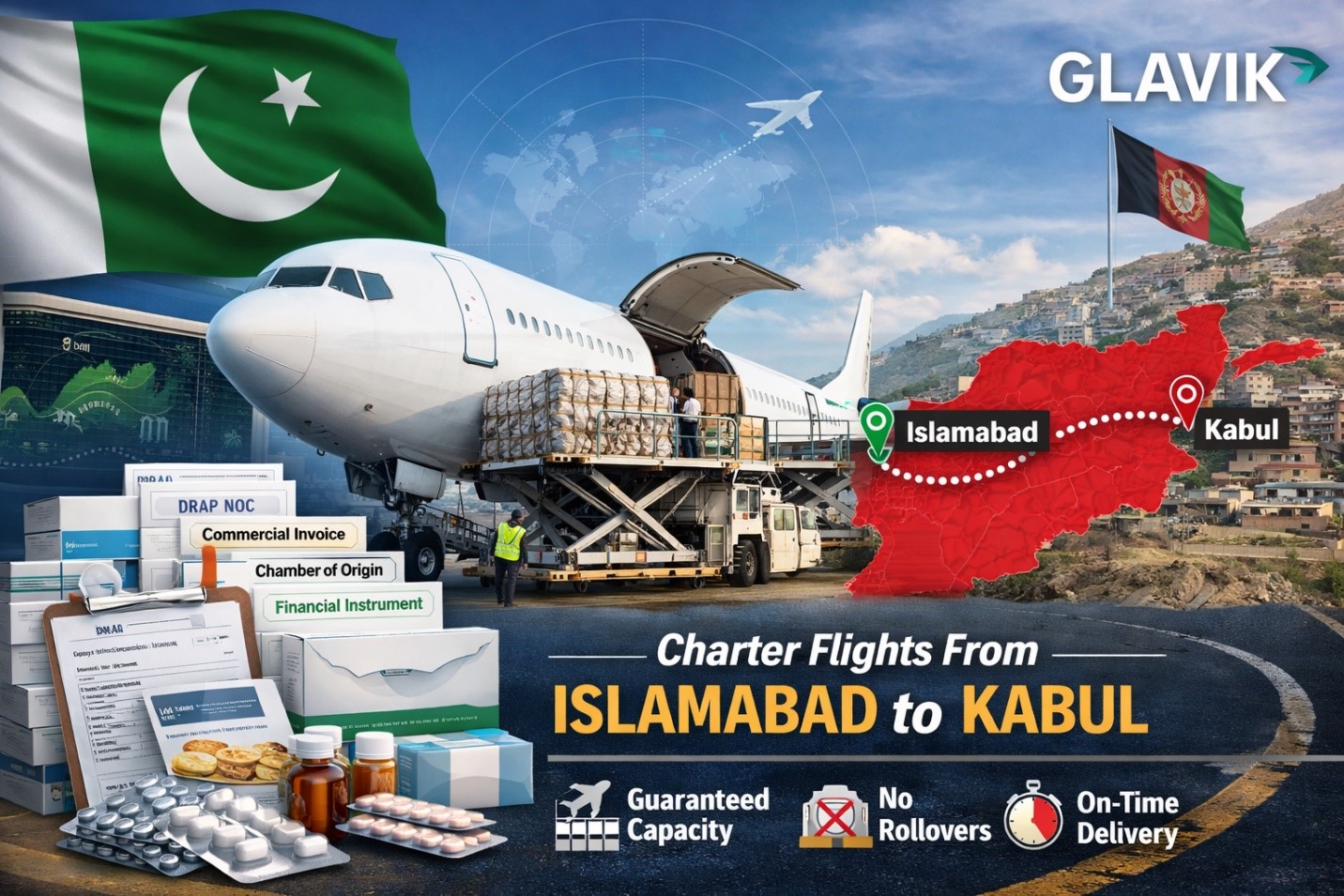
Trade between Pakistan and Afghanistan has entered a complex phase. With land routes restricted, political tensions rising, and border trade becoming unpredictable, air freight has emerged as the only viable channel for pharmaceutical exports.
At the same time, Afghanistan continues to rely heavily on imported medicines, while nearly 30% of Pakistan’s pharmaceutical exports are destined for the Afghan market. This creates a critical dependency—yet exporters face serious challenges such as overbooked airlines, cargo rollovers, demurrage losses, and unreliable transit timelines.
This article explains the complete ground reality of pharma exports from Pakistan to Afghanistan, covering:
- Political and trade disruptions
- Mandatory export documentation
- Why commercial airlines fail exporters
- Costly transit alternatives
And how Glavik solves these challenges through dedicated charter flights from Islamabad to Kabul
Political Rift Between Pakistan and Afghanistan and Its Impact on Trade
Trade between Pakistan and Afghanistan has always been influenced by political dynamics. In recent years, strained relations, security concerns, and policy uncertainty have directly impacted cross-border trade, particularly through land routes.
How Political Tensions Affect Trade
- Frequent border closures and restrictions
- Sudden changes in cross-border movement policies
- Increased scrutiny on commercial shipments
- Uncertainty for exporters and importers
As a result, land-based trade has become commercially unreliable, forcing businesses to seek alternatives that are less dependent on border decisions.
Afghanistan’s Dependency on Pakistan as a Landlocked Country
Afghanistan is a landlocked economy with limited direct access to global markets. Historically, Pakistan has served as:
- Afghanistan’s primary trade corridor
- A gateway to seaports
- A key supplier of essential goods
Any disruption in Pakistan–Afghanistan relations immediately affects Afghanistan’s supply chain, particularly for critical commodities like pharmaceuticals.
Impact on Pakistan’s Pharmaceutical Exports to Afghanistan
The political and trade disruption has significantly impacted Pakistan’s pharmaceutical sector:
- Almost 30% of Pakistan’s pharma exports are directed to Afghanistan
- Land route instability has caused:
- Shipment delays
- Rising logistics costs
- Reduced export volumes
- Exporters face:
- Inventory pile-ups
- Cash-flow pressure
- Market uncertainty
Despite strong demand in Afghanistan, political friction has turned a stable trade lane into a high-risk corridor.
Why Air Freight Became the Only Practical Solution
Given the instability of land routes, air freight is no longer a choice—it is a necessity.
Advantages of Air Freight
- Bypasses border uncertainty
- Faster transit times
- Better control over sensitive pharma cargo
- Regulatory clarity
However, air freight to Afghanistan brings its own set of challenges.
How Pharma Air Freight from Pakistan to Afghanistan Works
Standard Export Flow
- Exporter prepares medicines and documentation in Pakistan
- Cargo is delivered to Islamabad airport
- Shipment moves via:
- Commercial airline
- Transit route
- Or charter flight
- Cargo arrives at Kabul airport
- Consignee arranges customs clearance and delivery
Execution at Step 3 is where most exporters fail.
Mandatory Documents for Pharma Air Export to Afghanistan
Documents Provided by Exporter / Shipper
- Packing List
- Commercial Invoice
- DRAP NOC (mandatory for pharmaceuticals)
- Chamber Letter of Origin
- Financial Instrument (FI) – Mandatory
- Confirms payment received from buyer
- Required for Pakistan customs clearance
Important:
Without a valid Financial Instrument, export clearance will not proceed, regardless of airline availability.
Major Air Freight Challenges Exporters Face
Overbooking on Afghan Airlines (Kam Air)
Kam Air is commonly used due to lower freight rates, but:
- Cargo space is severely limited
- Flights are consistently overbooked
- Shipments roll over repeatedly
Cargo Rollovers & Financial Loss
- Cargo remains stuck at origin
- Demurrage and detention escalate
- Exporters absorb the cost
- Pharma cargo risks expiry and temperature deviation
Reality: Cheap freight often becomes the most expensive option.
Transit Routes via Dubai, Sharjah, or Turkey: Costly Alternatives
Some exporters route shipments via:
- Dubai
- Sharjah
- Turkey
While possible, these options involve:
- Much higher freight costs
- Longer transit times
- Additional handling risks
- Reduced viability for urgent or bulk pharma shipments
The Only Reliable Solution: Charter Flights from Pakistan to Afghanistan
Why Charter Flights Work
- Guaranteed aircraft capacity
- No overbooking
- No rollovers
- Fixed and predictable schedules
Charter flights are ideal for:
- Bulk pharmaceutical shipments
- Time-sensitive medicines
- Institutional or humanitarian supplies
Glavik’s Role: Ensuring Continuity Despite Political and Trade Uncertainty
This is where Glavik plays a decisive role.
What Glavik Does
- Regularly operates charter flights from Islamabad to Kabul
- Secures dedicated aircraft capacity
- Plans shipments only after exporter readiness confirmation
- Coordinates closely with:
- Airlines
- Ground handling agents
- Exporters and consignees
Clear Positioning:
While political tensions disrupt trade routes, Glavik ensures pharmaceutical supply chains remain uninterrupted.
Clear Division of Responsibilities
Exporter Responsibilities (Pakistan Side)
- Packing List & Commercial Invoice
- DRAP NOC
- Chamber Letter of Origin
- Financial Instrument
- Cargo readiness at Islamabad airport
Consignee Responsibilities (Afghanistan Side)
- Landing rights
- Import customs clearance
- Local delivery
Glavik ensures smooth coordination between both sides to prevent delays.
Why Pharma Exporters Choose Glavik
- Proven Afghanistan air freight expertise
- Active charter flight operations
- Zero rollover risk
- Predictable delivery timelines
- Compliance-driven execution
Conclusion: Reliability Is the Real Competitive Advantage
Pakistan–Afghanistan trade is currently shaped by political realities, border uncertainty, and operational risk. For pharmaceutical exporters, reliability matters more than low freight rates.
Glavik provides certainty—through charter flights, regulatory clarity, and disciplined execution—ensuring medicines reach Afghanistan on time, every time, regardless of political or logistical challenges.
Exporting pharmaceuticals to Afghanistan?
Avoid airline rollovers, demurrage losses, and political uncertainty.
👉 Partner with Glavik for guaranteed charter flights from Islamabad to Kabul.
We deliver:
- Confirmed uplift
- Zero rollovers
- Predictable timelines