

The Ultimate Guide to Shipping Lithium Batteries by Air (2025 Edition)
A Complete Guide to Air Transport Compliance for Lithium Batteries

Introduction
Transporting lithium batteries by air remains one of the most regulated areas in logistics.
Improper classification, packaging, or labeling can result in serious safety violations and shipment rejections by airlines.
This guide summarizes the IATA Dangerous Goods Regulations (DGR 2025) requirements for lithium-ion (rechargeable) and lithium-metal (non-rechargeable) batteries — including those contained in or packed with equipment — along with key airline acceptance standards and documentation rules.
1. Battery Classification Overview
| Type | UN Number | Description | Common Use |
| Lithium-ion batteries | UN3480 | Batteries only | Power banks, e-bikes |
| Lithium-ion batteries contained in equipment | UN3481 | Installed in a device | Laptops, cameras |
| Lithium-ion batteries packed with equipment | UN3481 | Shipped with device but not installed | Tools, kits |
| Lithium-metal batteries | UN3090 | Batteries only | Non-rechargeable cells |
| Lithium-metal batteries contained in equipment | UN3091 | Installed in device | Medical instruments |
| Lithium-metal batteries packed with equipment | UN3091 | Shipped with but not installed | Measuring equipment |
2. Key IATA Packaging Requirements
🧱 Packaging Classifications
- Cells ≤ 20 Wh / Batteries ≤ 100 Wh:
May fall under Section II — only when all Section II criteria under PI 965–970 are met.
⚠️ Note: Small standalone UN3480 lithium-ion cells may still fall under Section IB, not Section II. - Above 100 Wh:
Must be declared as fully regulated Dangerous Goods under Section I (IA or IB) of the applicable Packing Instruction (PI 965–970). - Packaging must meet UN Performance Standards (UN Marking):
Required only for Section I shipments under PI 965/966/968/969 — not for Section II. - 3 Testing:
Each cell and battery design must have successfully passed the UN Manual of Tests and Criteria, Part III, Subsection 38.3.
A Test Summary Report must be available upon request. - Short-circuit protection:
All batteries must have terminals insulated and be placed in strong, rigid outer packaging that prevents movement and contact.
3. Labeling and Marking Requirements
| Label / Mark | Requirement | Applicable Sections | Notes |
| Lithium Battery Mark (Rectangular Mark) | Indicates presence of lithium batteries | Section II and IB | Required for most small lithium shipments (UN3480/3481/3090/3091) |
| Model 9A Lithium Battery Hazard Label | Class 9 hazard label | Section I (IA/IB) | Mandatory for all fully regulated shipments |
| Cargo Aircraft Only (CAO) Label | Orange “CAO” label | Section I (IA/IB) of UN3480, UN3481, UN3090, UN3091 | Required when packages exceed passenger aircraft limits or as specified in PI |
| UN Number Marking | UN3480, UN3481, UN3090, or UN3091 | All | Must be clearly visible and durable on outer packaging |
4. Documentation Requirements
| Document | Required For | Description |
| Shipper’s Declaration for Dangerous Goods (DGD) | Section I (IA & IB) | Must be completed and signed per IATA DGR 8.1.6 |
| Air Waybill (AWB) | All | For Section I, include statement: “Dangerous Goods as per attached Shipper’s Declaration.” For Section II, note lithium battery presence as per airline SOP. |
| Material Safety Data Sheet (MSDS) | Recommended for all | Not mandatory but supports acceptance, handling, and emergency response. |
| Lithium Battery Test Summary (UN38.3) | All | Must be readily available upon request by the operator or authority. |
| Additional Airline or State Documents | Case by case | Some carriers (e.g., Emirates, Qatar Airways) may require pre-approval or checklists for lithium shipments. |
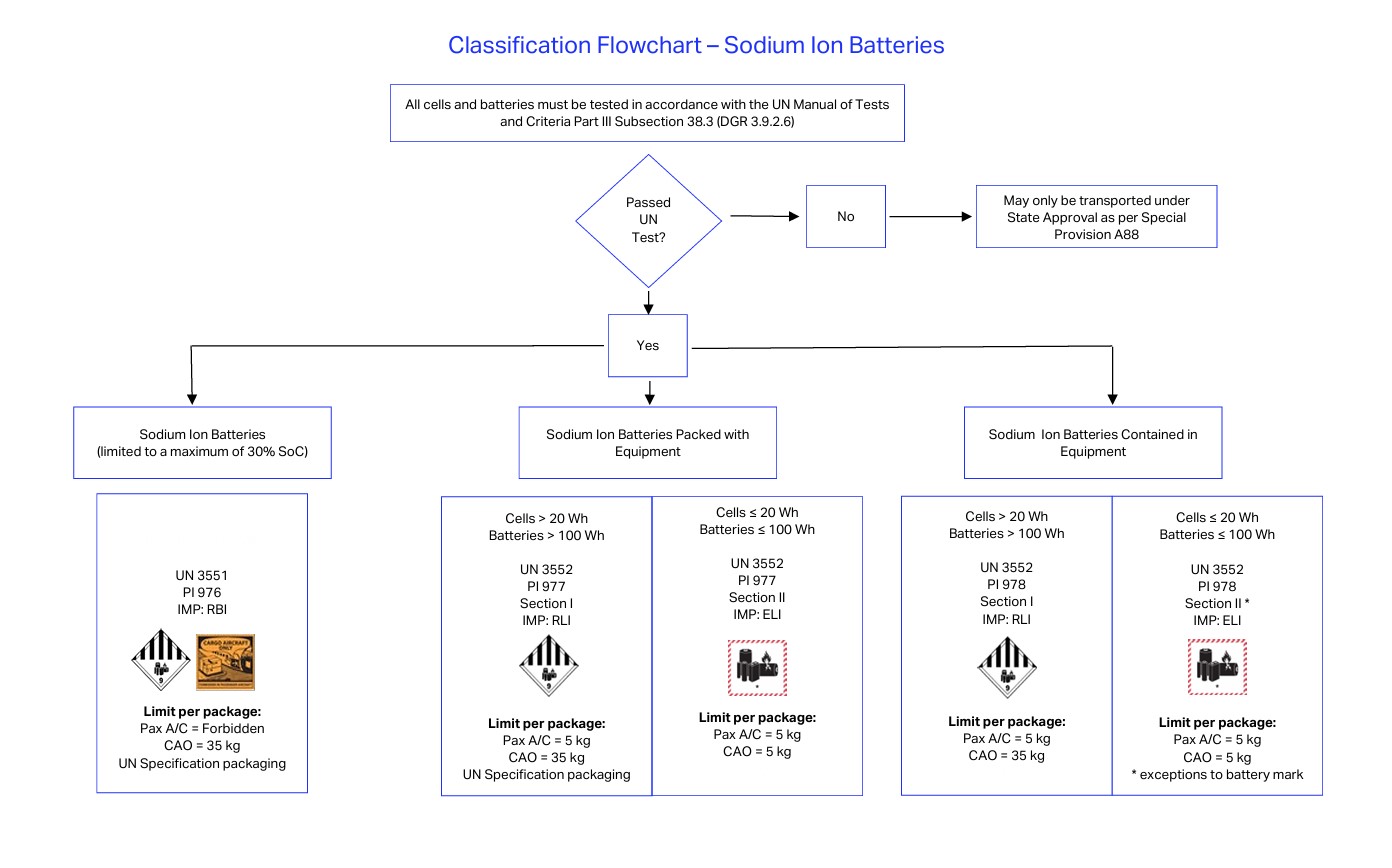
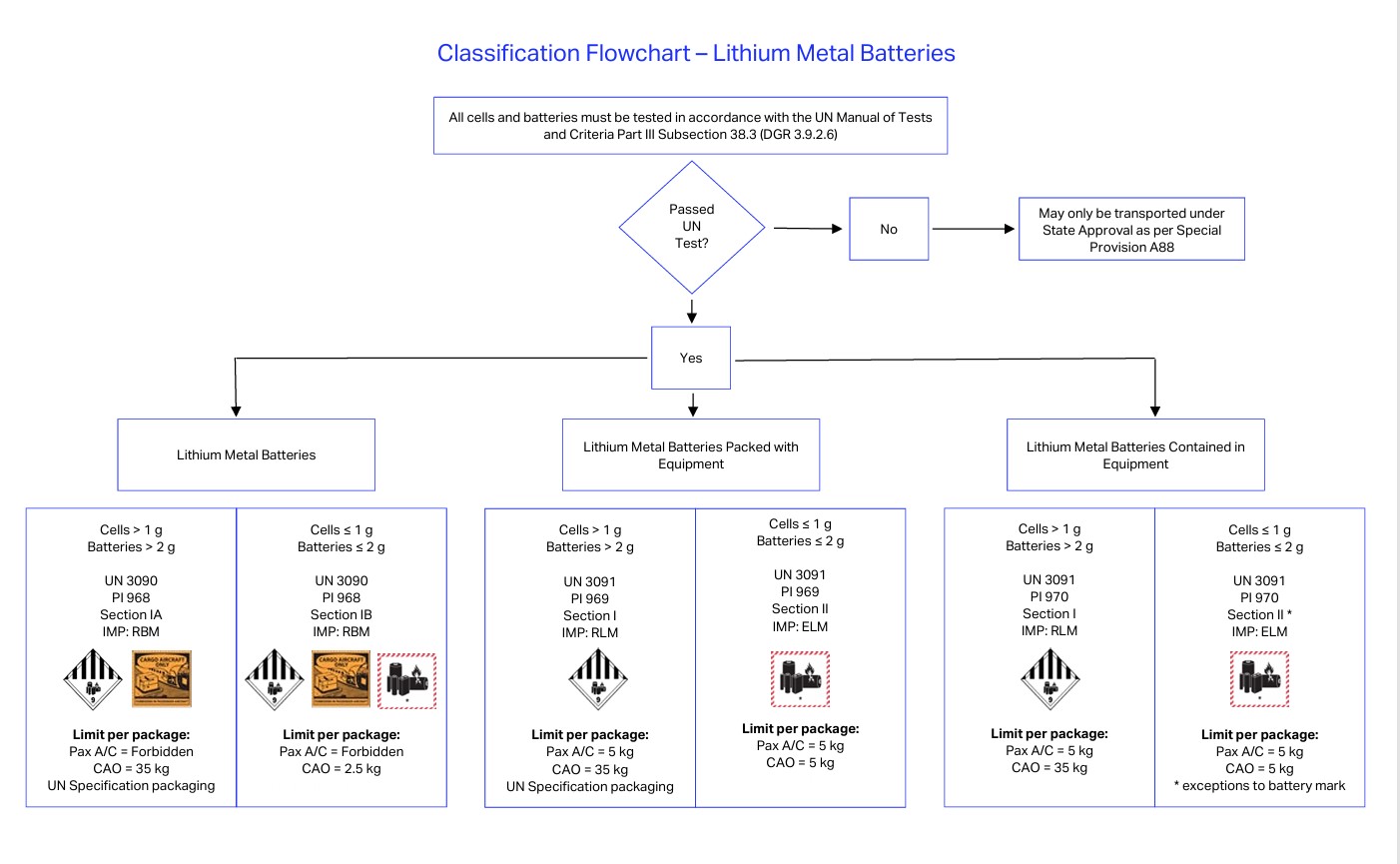
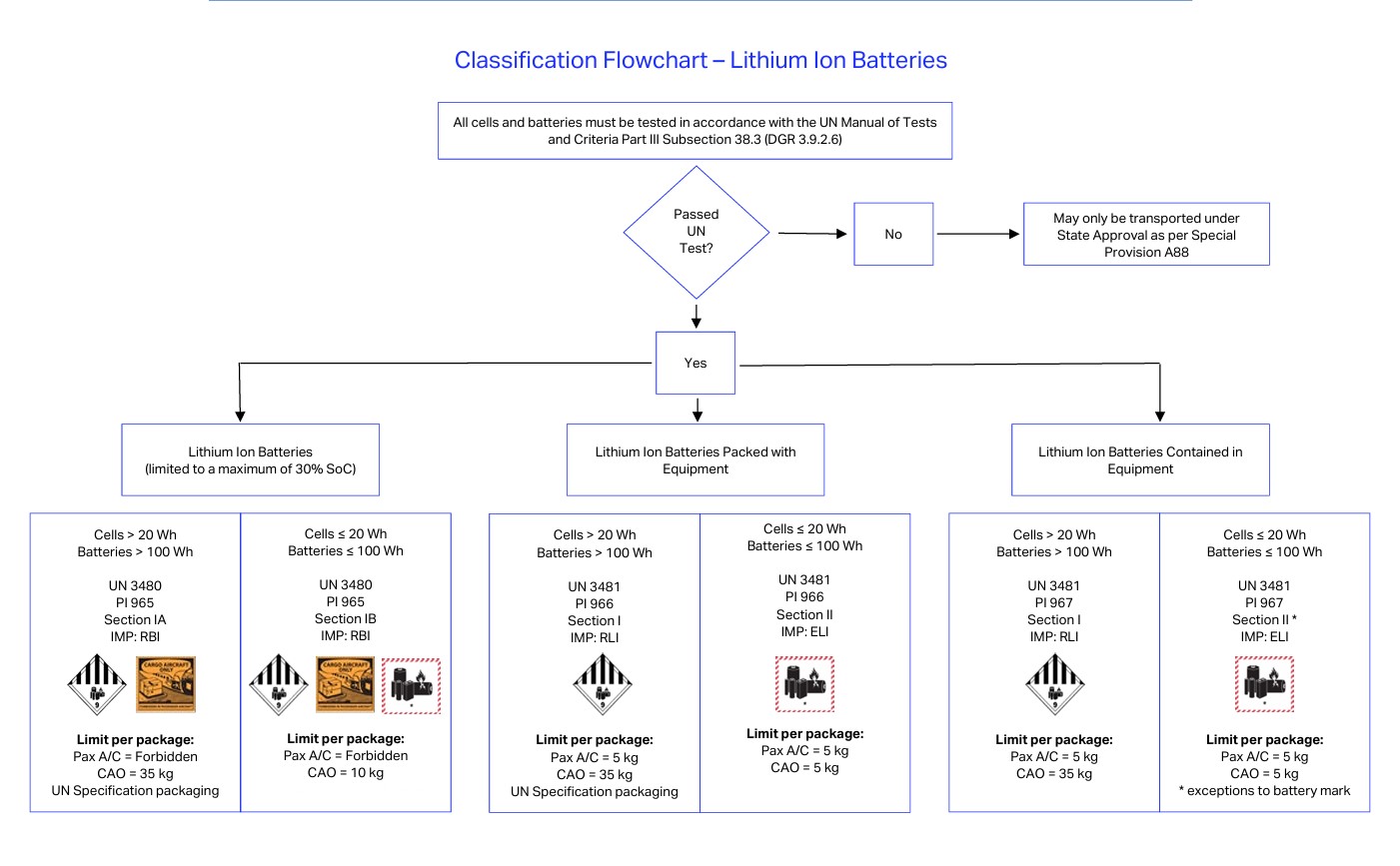
5. Classification Flowcharts
Three decision flowcharts are used to determine the correct section and packaging instruction:
- Lithium-ion Batteries (UN3480/3481)
- Lithium-metal Batteries (UN3090/3091)
- Sodium-ion Batteries (new entries per DGR 2025)
Each flowchart defines whether the shipment qualifies for Section II, IB, or IA, based on:
- Watt-hour rating (Wh)
- Net quantity per package
- Cell/battery configuration (with/without equipment)
- Type of aircraft (passenger vs cargo)
Local Pakistan Civil Aviation & Airline Rules
When shipping from Pakistan, lithium battery air shipments must comply with:
- PIA, Qatar Airways, Emirates, Turkish Airlines, and Etihad – each airline has its own acceptance checklist for lithium batteries.
- PIA and Qatar Airways often require battery manufacturer certificates and UN38.3 reports before acceptance.
- Civil Aviation Authority (CAA Pakistan) enforces IATA DGR alignment, meaning documentation and packaging must meet IATA Chapter 3 and 8 requirements.
- Exporters must ensure Shipper’s Declaration signed by a DG-certified person (IATA DG Cat 6 trained).
Glavik’s DG-certified team handles end-to-end process, from documentation, classification, and packaging to airline coordination and pre-alerts.
6. Common Misconceptions Clarified
| Misunderstanding | Correct Information |
| “All small batteries under 100 Wh are Section II.” | ❌ Not true. UN3480 small batteries may fall under Section IB depending on configuration. |
| “All lithium packaging must be UN approved.” | ❌ Not true. Only Section I packages require UN performance-tested packaging. |
| “The lithium label is a Class 9 hazard label.” | ❌ The battery mark (rectangular) is not a hazard label. The Class 9A hazard label applies to fully regulated shipments only. |
| “CAO label applies only to UN3480.” | ❌ The CAO label may also apply to UN3481 and UN3091 depending on weight and aircraft restrictions. |
| “3 Test Report Copy” | ❌ The correct term is UN38.3 Test Summary Report — must be maintained by the shipper and provided upon request. |
Lithium Battery Checklist Before Shipping by Air
| ✅ Checkpoint | Requirement |
| Battery type identified (Li-ion / Li-metal) | ✔ |
| Wh rating clearly labeled | ✔ |
| Packaging meets UN standards | ✔ |
| UN38.3 test report available | ✔ |
| DGD prepared and signed by DG certified person | ✔ |
| Handling label applied | ✔ |
| MSDS attached | ✔ |
7. Key Takeaways
✅ Verify UN number and correct Packing Instruction (PI 965–970).
✅ Ensure all batteries are UN38.3 tested and documented.
✅ Apply correct label combination — Battery Mark, Class 9A, CAO — based on section and mode.
✅ Maintain DGD and AWB documentation consistency.
✅ Stay updated — IATA revises lithium provisions annually.
✈️ Glavik’s Expertise
At Glavik Dangerous Goods Division, we manage lithium battery shipments for medical, industrial, and electronics manufacturers worldwide — ensuring compliance with IATA, ICAO, PNRA, and DRAP standards in Pakistan.
For compliant air export of lithium-ion or lithium-metal batteries, or battery-powered equipment:
📩 hq@glavik.com | 🌐 www.glavik.com