
When 50 Metric Tons of Medicine Cannot Wait
CCL Pharmaceuticals — Pakistan’s Most Complex Pharmaceutical Logistics Operation, Executed Without a Single Breach
If you work in pharmaceutical imports, hospital procurement, or life sciences supply chain in Pakistan, you already know this feeling: a critical shipment is in motion, the pressure is real, and you are trusting a logistics partner with cargo that cannot afford to fail. Medicines that patients are waiting for. Equipment a hospital has already paid for. Biological samples under strict chain-of-custody. Temperature-sensitive products that expire if they sit.
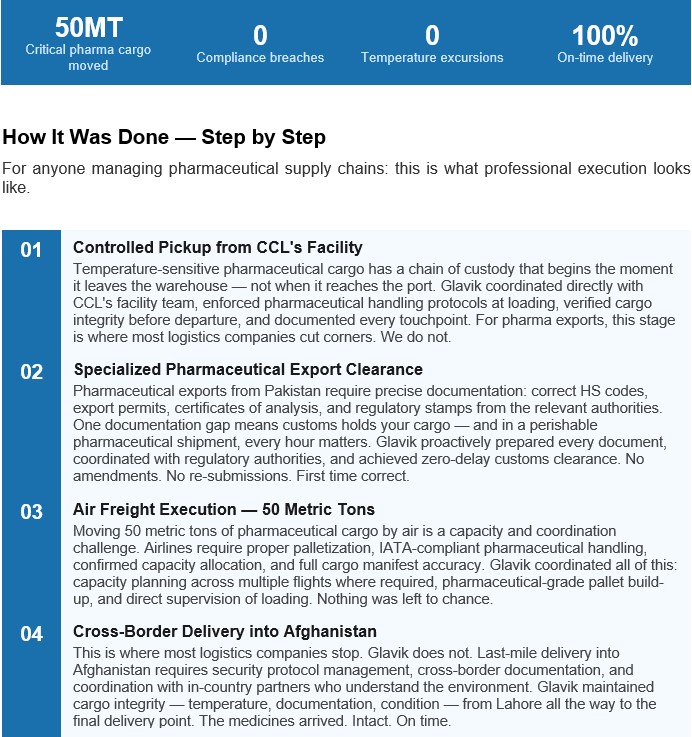
This is the story of what happened when CCL Pharmaceuticals — one of Pakistan’s largest pharmaceutical companies — put exactly that kind of trust to the test. 50 metric tons of life-saving medicines. Destination: Afghanistan. Zero margin for error.
What Made This Shipment Different
Most pharmaceutical logistics articles talk about the easy wins. This is not one of those.
Afghanistan is one of the most operationally demanding destinations in the world for a pharmaceutical shipment. Cross-border clearance is unpredictable. Security protocols are non-negotiable. Documentation requirements are strict, because any gap — one wrong certificate, one HS code mismatch, one missing regulatory stamp — stops the cargo at the border.
And 50 metric tons is not a small parcel. It requires airline capacity planning, pharmaceutical-grade palletization, cold-chain management from point of origin, coordinated handoffs across jurisdictions, and end-to-end cargo integrity from CCL’s facility in Pakistan to the final delivery point inside Afghanistan.
For a pharmaceutical importer or exporter reading this: you know exactly how many things can go wrong in a chain like this. Temperature excursion during transfer. A documentation discrepancy at customs. A capacity gap with the airline. A last-mile delivery team that does not understand pharma handling protocols.
None of those things happened here. Here is how.
CASE STUDY │ CCL PHARMACEUTICALS │ CRITICAL PHARMA CARGO
50 Metric Tons of Life-Saving Medicine — Zero Margin for Error
Client: CCL Holdings / CCL Pharmaceuticals
Cargo: 50 Metric Tons of critical pharmaceutical products — finished medicines, APIs, packaging
Destination: Afghanistan — one of the world’s most operationally complex environments
Regulatory requirements: Export documentation, pharma-grade customs clearance, cross-border compliance, IATA handling standards
Scope: Full end-to-end execution: secure facility pickup → specialized customs clearance → air freight management → last-mile delivery into Afghanistan
Result: Mission completed. Zero compliance breach. Zero delays. Every consignment delivered intact.
What This Means for Pharmaceutical Importers and Exporters
If you are a pharmaceutical company, medical importer, life sciences distributor, or hospital procurement manager reading this — there is a specific reason this case study matters to you.
The pharmaceutical supply chain has no tolerance for improvisation. IATA DGR compliance is not optional — airlines reject non-compliant pharma shipments at the gate. Cold-chain documentation is not a formality — a temperature excursion can make an entire consignment unsaleable. Customs documentation accuracy is not a best-effort exercise — one missing certificate triggers a hold that costs you money every single day.
The question is not whether a logistics company can “try their best” with your pharmaceutical cargo. The question is whether they have done it before — correctly — at this scale.
Glavik has. This is the evidence.
If Glavik can deliver 50 metric tons of pharmaceutical cargo into Afghanistan without a single compliance breach, documentation error, or temperature excursion — your pharmaceutical import into Karachi or Lahore is something we can handle with complete confidence. But we never treat any shipment as routine.
Real Story #2: Cargo Stuck. Millions at Risk. Glavik Intervened.
This one is different. This is not a story of a complex operation executed from the start. This is a story of what happened when another logistics company had already failed — and what Glavik did about it.
A major pharmaceutical shipment for CCL arrived at Karachi port. The paperwork came with it. The cargo went into port. And then — nothing. Days passed. The shipping line’s free time ran out.
WHAT IS DEMURRAGE — AND WHY IT DESTROYS PHARMACEUTICAL BUDGETS
When your cargo sits at a Pakistani port beyond the free time window (typically 3–5 days for imports), the shipping line begins charging a daily demurrage fee for the container. For a pharmaceutical shipment of significant volume, these charges typically run:
- PKR 500,000 to PKR 1,000,000 per day for standard pharmaceutical containers
- PKR 1,000,000 to PKR 2,000,000+ per day for large or temperature-controlled shipments
- Separate detention charges if the container leaves the port before cargo is cleared
These charges compound daily, with no ceiling. A shipment stuck for 10 days can cost PKR 10–20 million in port charges alone — before you factor in the cost of product expiry, delayed patient access, or hospital launch disruption.
Most pharmaceutical companies in Pakistan discover this problem after it has already cost them millions. Glavik exists to prevent it from happening at all — and to resolve it fast when it does.
What Happened — The Real Sequence
CCL’s shipment was not stuck because of bad luck. It was stuck because the original clearing agent had submitted documentation with a mismatch — a discrepancy between the cargo manifest and the regulatory paperwork. It is the kind of error that a general freight forwarder without pharmaceutical customs expertise makes. And it is the kind of error that Pakistan Customs does not overlook.
Customs placed a hold. Demurrage charges began running. The original agent could not resolve it. CCL made the call.
Glavik received the emergency. We moved within hours.
What Glavik Did — In Sequence
- Dispatched our customs team directly to Karachi port to physically assess the hold
- Identified the exact documentation mismatch — the specific field and the specific discrepancy
- Coordinated directly with the customs officers handling the file — not through intermediaries
- Prepared corrected documentation and submitted through the correct regulatory channel
- Obtained customs clearance and secured cargo release
What This Tells You About Pharmaceutical Logistics in Pakistan
Every pharmaceutical importer, medical equipment buyer, and dangerous goods shipper in Pakistan faces this risk. The documentation is complex. The regulatory requirements are real. Pakistan Customs does not accept approximations.
The question is not whether something will go wrong in your supply chain. The question is what your logistics partner does when it does.
A general freight forwarder calls you with the problem. Glavik calls you with the solution.
The Hard Truth for Pharmaceutical and Healthcare Importers
CCL did not need a better shipping rate. They needed a team that knew exactly which customs officer to speak to, which regulatory instrument applied to their cargo, and how to resolve a compliance hold in hours rather than weeks.
That is what Glavik does. That is what we were built for.
If your cargo is stuck right now — call Glavik: +92 321 4591020
We respond to cargo emergencies within 2 hours.
Who Needs to Read This
If your business involves any of the following, this case study is directly relevant to your procurement and logistics decisions:
- Pharmaceutical companies importing APIs, finished medicines, or biologics into Pakistan — where documentation accuracy and DRAP compliance are non-negotiable
- Medical equipment importers and hospital procurement teams — where customs delays directly delay patient care and generate demurrage charges on expensive capital equipment
- Life sciences companies moving biological samples, reagents, or research materials internationally — where IATA DGR compliance determines whether your cargo reaches the destination or is rejected at the airline gate
- Dangerous goods importers and exporters — where one classification error means airline rejection, regulatory fines, or cargo seizure
- Anyone whose current logistics partner has caused a documentation hold, customs delay, or compliance breach in the past 12 months
You are not looking for the cheapest rate. You are looking for the partner who will not cost you ten times the savings when something goes wrong.
Protect Your Next Pharmaceutical or Healthcare Shipment
Call/WhatsApp: +92 321 4591020
Email: hq@glavik.com | Website: www.glavik.com
Cargo stuck right now? Our crisis desk responds within 2 hours.